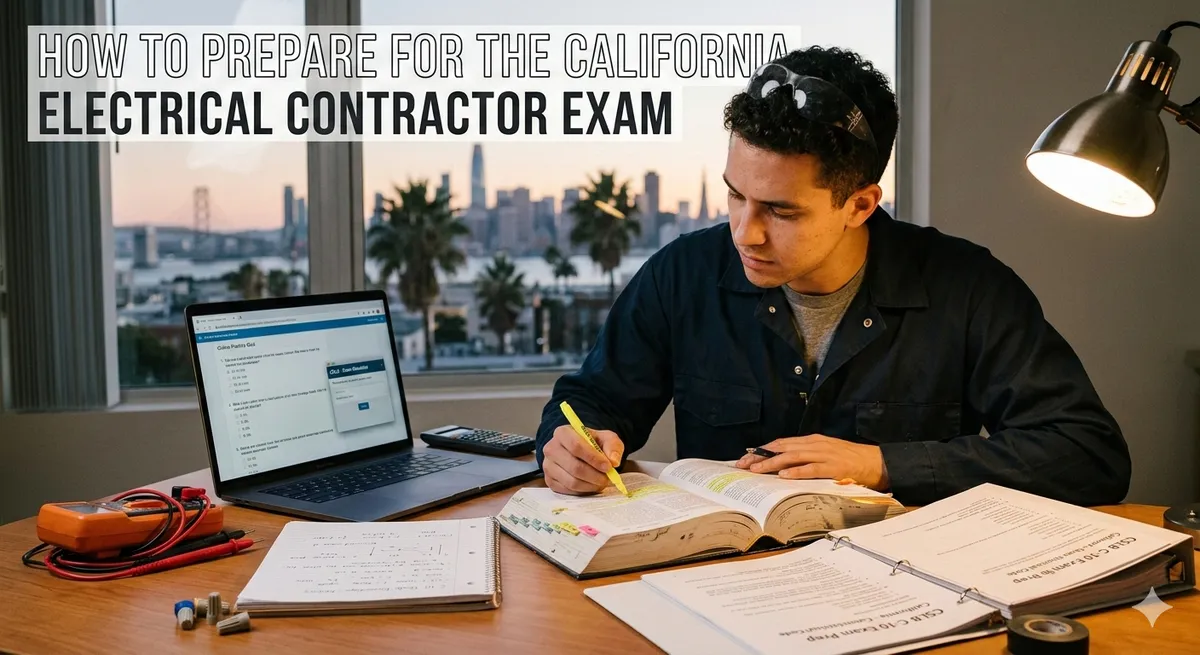
A comprehensive guide to studying for the C-10 exam, including recommended books, study schedules, and what to expect on test day at the PSI center.
Passing the CSLB C-10 Electrical Contractor exam is the final hurdle between you and running your own electrical contracting business in California. Both the C-10 Trade exam and the Law & Business exam are closed-book, so preparation and memorization are key to passing on the first try.
Understanding the C-10 Exam Structure
The CSLB C-10 exam is actually two separate exams that you must pass: the C-10 Trade exam and the Law & Business exam. Each exam has 115 multiple-choice questions, requires a 72% passing score, and gives you 3 hours and 30 minutes to complete. Both exams are administered at PSI testing centers across California and are completely closed-book — no reference materials allowed.
1. Master the NEC Concepts
Since the CSLB C-10 exam is closed-book, you cannot bring the NEC code book into the test center. Instead of memorizing every article, focus on understanding the core concepts and formulas that appear most frequently on the exam. The key is building deep understanding rather than rote memorization.
- Key Articles: Focus on Article 220 (Calculations), Article 230 (Services), Article 250 (Grounding & Bonding), Article 310 (Conductors), and Article 430 (Motors).
- Memorize Formulas: Voltage drop, box fill, conduit fill, and load calculation formulas must be committed to memory. Write them down on scratch paper immediately when you sit down at the testing center.
- Understand Concepts: Know the difference between grounding and bonding, conductor sizing rules, overcurrent protection requirements, and how to apply temperature correction factors.
- NEC Table Knowledge: While you won't have the tables in front of you, you should know the most common values from Table 310.16 (conductor ampacities) and Table 250.66 (grounding electrode conductors).
2. Master Load Calculations
The C-10 Trade exam heavily features electrical calculations. These are not questions you can guess on — they require specific mathematical skills and knowledge of NEC calculation methods. Plan to spend at least 30% of your study time on calculations alone.
- Dwelling Unit Calculations: Both Standard Method (Article 220) and Optional Method (Article 220.82) will appear on the exam. Know when to use each method.
- Motor Calculations: Understand the difference between Full Load Current (FLC from NEC tables) and nameplate Full Load Amps (FLA). Know how to size conductors, overload protection, and short-circuit protection for motors.
- Box Fill Calculations: Article 314 questions are common. Know the volume allowances for different conductor sizes, clamps, devices, and equipment grounding conductors.
- Voltage Drop: The formula VD = (2 × K × I × D) / CM must be memorized. Keep voltage drop under 3% for branch circuits and 5% total for feeders plus branch circuits.
- Conduit Fill: Chapter 9, Table 1 limits and how to calculate cross-sectional areas for multiple conductors in conduit.
Pro Tip: Watch Your Units
Always check if the question asks for Watts, Kilowatts, VA, or Amps. A common CSLB trick is to give answer choices in different units. Convert everything to the same unit before solving, and double-check your decimal placement. Many candidates lose points not because they don't know the material, but because they rush through the unit conversions.
3. Don't Ignore the Law & Business Exam
Many skilled electricians fail because they underestimate the Law & Business exam. This separate closed-book exam is just as important as the Trade exam — you must pass both to receive your C-10 license. The L&B exam covers a wide range of topics that have nothing to do with electrical work:
- California Business and Professions Code: Contractor licensing requirements, grounds for discipline, advertising rules, and home improvement contract requirements.
- California Labor Code: Workers' compensation requirements, prevailing wage laws, employee vs. independent contractor classifications, and workplace safety obligations.
- Mechanics Lien Law: Preliminary notices, lien deadlines, stop payment notices, and the Public Works claims process. This is one of the most heavily tested areas.
- Cal/OSHA Safety Orders: Electrical safety orders, trenching requirements, fall protection, and the Injury & Illness Prevention Program (IIPP) requirement.
- Contract Law: Elements of a valid contract, breach remedies, change order procedures, and California's right to cancel provisions.
- Financial Management: Basic accounting, estimating, project management, insurance requirements, and bonding obligations.
4. Create a Study Schedule
Most successful candidates study for 6-8 weeks before the exam. Here's a recommended breakdown:
- Weeks 1-2: Focus on NEC fundamentals — review key articles, memorize core formulas, and work through basic calculation problems.
- Weeks 3-4: Deep dive into load calculations, motor circuits, and grounding/bonding. Take practice quizzes on each topic.
- Weeks 5-6: Start studying Law & Business material. Focus on mechanics liens, safety regulations, and contract law.
- Weeks 7-8: Take full-length practice exams under timed conditions. Review your weak areas and re-study topics where you score below 80%.
5. Take Practice Exams
The best way to prepare for a closed-book exam is to simulate the real test environment. Our platform provides 950+ practice questions for each exam, organized by topic, so you can build the recall speed needed for the 3.5-hour time limit. Practice exams help you:
- Identify knowledge gaps before the real exam
- Build confidence with timed test simulations
- Learn the CSLB question format and common answer patterns
- Track your progress over time and focus on weak areas
Exam Day Reminder
Bring two forms of valid ID to the PSI center. Arrive at least 30 minutes early. You'll be given scratch paper and a basic calculator at the testing center. No personal items (phone, watch, bag) are allowed in the testing room. Use the scratch paper immediately to write down key formulas before you start answering questions.
Ready to Pass Your Exam?
Put your knowledge to the test. Try our free California C-10 practice test to see where you stand, or upgrade to our Premium Preparation Course for unlimited mock exams, detailed explanations, and a 100% pass guarantee.
Recommended Articles
Top 5 NEC Articles Every C-10 Candidate Must Know
Don't waste time memorizing the entire code book. These 5 articles appear on over 60% of C-10 trade exam questions.
C-10 Exam Day: What to Expect at the PSI Center
Walk through the entire exam day process, from check-in procedures to the computer interface and time management strategies for the 3.5-hour test.
7 Common Mistakes That Cause Electricians to Fail the C-10 Exam
Learn from the failures of others. We analyzed common pitfalls in the C-10 trade portion to help you pass on your first try.