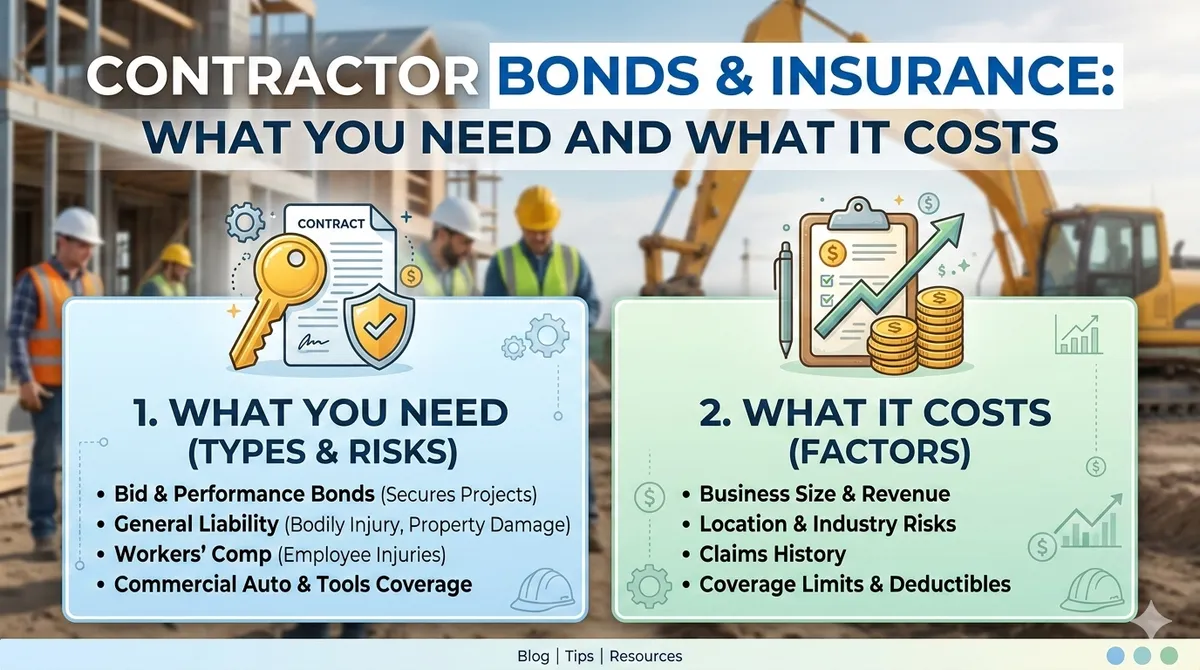
A breakdown of the personal and business financial requirements for becoming a licensed C-10 contractor.
Before CSLB will issue your C-10 license, you must meet specific bonding and insurance requirements. Understanding these financial obligations upfront helps you plan your budget and avoid surprises.
Contractor's License Bond ($25,000)
Every California contractor must maintain a $25,000 contractor's license bond. This bond protects consumers — if you are found liable for damages, the surety company pays the consumer (up to $25,000) and then comes to you for reimbursement.
- Bond amount: $25,000 (this is NOT what you pay — this is the maximum coverage amount)
- Annual premium: Typically $100-500 per year, depending on your credit score and history
- Good credit (700+): Expect $100-200/year premium (about 1% of bond amount)
- Fair credit (600-699): Expect $200-400/year premium (about 1.5-2%)
- Poor credit (below 600): Expect $400-750/year premium (about 2-3%)
- Must be maintained continuously: If your bond lapses, your license is automatically suspended
Qualifying Individual (QI) Bond ($12,500)
If the qualifying individual (the person whose experience qualifies the company for the license) is NOT an owner of the business, an additional $12,500 bond is required:
- When required: Only when the qualifier is a Responsible Managing Employee (RME), not an owner
- Not required: If the qualifier is an owner, partner, or officer (RMO) of the company
- Annual premium: Typically $50-250/year, similar credit-based pricing as the contractor bond
Workers' Compensation Insurance
California law requires all employers to carry workers' compensation insurance. This is one of the most important insurance requirements for contractors:
- If you have employees: Workers' comp is mandatory. No exceptions. Coverage must be in place before any employee starts work.
- If you have no employees: You can file a Certificate of Exemption with CSLB. This certifies that you are a sole owner with no employees.
- Cost: Workers' comp premiums for electrical contractors are based on payroll amounts and typically range from $5-15 per $100 of payroll.
- Classification code: Electrical contractors typically fall under classification code 5190 for workers' comp rating.
- Penalties: Operating without workers' comp when required is a criminal offense in California (Labor Code Section 3700.5). Penalties include fines up to $100,000 and imprisonment.
Important: Certificate of Exemption
If you file a workers' comp exemption because you have no employees, be aware that this exemption must be updated if your situation changes. The moment you hire your first employee — even a part-time helper — you must immediately obtain workers' comp coverage and cancel your exemption. Failure to do so can result in license suspension and criminal penalties.
General Liability Insurance
While not required by CSLB for licensing, general liability insurance is essential for operating an electrical contracting business:
- Coverage: Protects against claims of property damage, bodily injury, and personal injury caused by your work
- Typical coverage amounts: $1 million per occurrence / $2 million aggregate is standard
- Annual cost: $500-3,000/year for a small electrical contractor, depending on revenue and claims history
- Often required: Most general contractors and property owners require subcontractors to carry GL insurance before working on their projects
- Additional insured: GCs typically require you to add them as an additional insured on your policy
Commercial Auto Insurance
If you use vehicles for business purposes (carrying tools, traveling to job sites), you should have commercial auto insurance. Personal auto policies typically exclude business use coverage.
Total Startup Insurance Costs
| Insurance/Bond | Annual Cost (Typical) | Required by CSLB? |
|---|---|---|
| Contractor's License Bond | $100-500/year | Yes |
| QI Bond (if applicable) | $50-250/year | Conditional |
| Workers' Comp Insurance | $2,000-15,000+/year | Yes (if employees) |
| General Liability Insurance | $500-3,000/year | No (but essential) |
| Commercial Auto Insurance | $1,200-3,000/year | No (but recommended) |
Budget Planning Tip
For a solo contractor with no employees, your minimum insurance costs will be approximately $600-1,500/year (contractor bond + general liability). If you plan to hire employees, budget an additional $5,000-15,000/year for workers' compensation. Factor these ongoing costs into your pricing and business plan before launching.
Ready to Pass Your Exam?
Put your knowledge to the test. Try our free California C-10 practice test to see where you stand, or upgrade to our Premium Preparation Course for unlimited mock exams, detailed explanations, and a 100% pass guarantee.
Recommended Articles
CSLB C-10 License Requirements: The 2026 Checklist
Everything you need to know about CSLB experience requirements, application fees, and licensing for 2026.
CSLB Application Process: Step-by-Step Guide
Don't let your application get rejected. Follow this walkthrough to fill out your CSLB forms correctly the first time.
California Electrical Code vs. NEC: What's on the Exam?
California has specific amendments to the NEC. We cover the key differences you'll see on the CSLB exam questions.