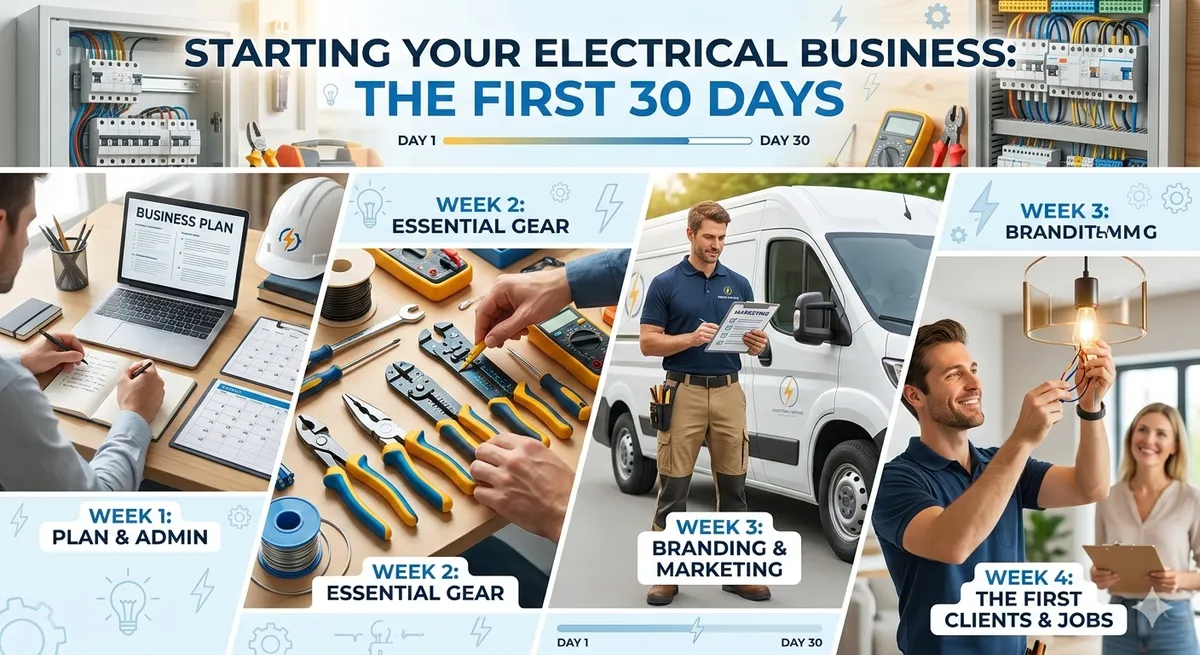
A tactical guide to launching your CSLB-licensed business: forming an LLC, getting bonds, and finding customers.
You passed both exams and received your C-10 license. Congratulations! Now the real work begins. Here's a tactical 30-day plan for launching your electrical contracting business in California.
Week 1: Legal Foundation
Day 1-2: Choose Your Business Entity
Your business structure affects your taxes, liability, and how you operate. The most common options for electrical contractors:
- Sole Proprietorship: Simplest to set up, but you're personally liable for all debts and claims. Best for solo operators just starting out.
- LLC (Limited Liability Company): Separates personal and business assets. Provides liability protection with simpler tax treatment than corporations. Most popular choice for small contractors.
- S-Corporation: Can save on self-employment taxes once profits exceed $50-60K. More complex paperwork and reporting requirements.
Recommendation: Start as an LLC and elect S-Corp taxation once your profits justify the added complexity and accounting costs.
Day 3-4: Register Your Business
- File your business entity with the California Secretary of State ($70 for LLC)
- Obtain your federal EIN (Employer Identification Number) from the IRS — free and instant online
- Register for a California seller's permit with the CDTFA (if you sell materials)
- File a DBA (Doing Business As) with your county if using a business name different from your legal name
- Apply for a local business license in your city/county
Day 5-7: Open a Business Bank Account
Never mix personal and business finances. Open a dedicated business checking account and consider:
- A business checking account with low or no monthly fees
- A business credit card for tracking tool and supply purchases
- A separate savings account for estimated taxes (set aside 30% of every payment)
Week 2: Financial & Insurance Setup
Day 8-10: Secure Insurance and Bonds
- Contractor's License Bond ($25,000): Required by CSLB. Shop around — premiums vary significantly between surety companies.
- General Liability Insurance: Get at least $1M/$2M coverage. Get quotes from 3+ providers.
- Commercial Auto Insurance: If using a vehicle for business. Discuss business use with your insurance agent.
- Workers' Comp or Exemption: File exemption if no employees, or purchase coverage immediately if hiring.
- Tools and Equipment Insurance: Inland marine policy to cover your tools, worth the small premium.
Day 11-14: Financial Systems
- Accounting software: QuickBooks Self-Employed or QuickBooks Online is the industry standard. Set it up properly from day one — fixing messy books later is expensive.
- Invoicing system: Use your accounting software or a dedicated tool to create professional invoices with your license number and business information.
- Estimating templates: Create standardized estimate templates for common jobs (panel upgrades, EV charger installs, circuit additions, etc.).
- Find an accountant: A CPA experienced with contractors can save you thousands in taxes and prevent costly mistakes.
Week 3: Marketing & Online Presence
Day 15-17: Build Your Online Presence
- Google Business Profile: This is #1 priority. Most residential customers find contractors through Google Maps. Complete your profile with photos, services, and business hours.
- Simple website: Even a one-page website with your services, license number, contact info, and a few photos of your work establishes credibility.
- Yelp profile: Important for residential work in California. Claim your listing and complete your profile.
Day 18-21: Start Networking
- Contact general contractors: Visit construction sites, introduce yourself, and leave business cards. Many GCs are constantly looking for reliable electrical subs.
- Join local builder associations: Local HBA (Home Builders Association) and ABC (Associated Builders and Contractors) provide networking opportunities and job leads.
- Property managers: Contact local property management companies. They need reliable electricians for maintenance and tenant improvements.
- Tell everyone: Your personal network is your first marketing channel. Let friends, family, and former colleagues know you're licensed and available.
Week 4: Operations & First Projects
Day 22-25: Set Up Operations
- Stock your truck: Carry common materials (wire, connectors, boxes, breakers) so you can complete small jobs immediately.
- Permit process: Familiarize yourself with the permit process in your local jurisdiction. Pull your first permit to learn the process.
- Contract templates: Create California-compliant contracts for residential and commercial work. Include your CSLB license number, bond information, and the required right-to-cancel notice for home improvement contracts.
Day 26-30: Land Your First Clients
- Respond to leads immediately — speed is your competitive advantage as a new contractor
- Price competitively (not cheapest, but fair) for your first projects to build reviews and portfolio
- Take photos of every completed job for your portfolio
- Ask every satisfied customer for a Google review (this compounds over time)
You're in Business!
The first 30 days set the foundation for everything that follows. Don't try to do everything perfectly — just get moving, take on work, deliver quality, and iterate. The contractors who succeed are the ones who consistently show up, do great work, and treat customers well. Your C-10 license opened the door. Now go build something great.
Ready to Pass Your Exam?
Put your knowledge to the test. Try our free California C-10 practice test to see where you stand, or upgrade to our Premium Preparation Course for unlimited mock exams, detailed explanations, and a 100% pass guarantee.
Recommended Articles
Law & Business vs. C-10 Trade Exam: Which is Harder?
We polled 500 CSLB candidates to find out which portion of the exam gave them more trouble. The results might surprise you.
Master to C-10 Contractor: Is the License Worth It?
The pros and cons of leaving your steady paycheck to start your own CSLB-licensed electrical contracting business.
Real Talk: How Much Do C-10 Contractors Actually Make?
We break down the potential income for licensed electrical contractors in California, from solo operators to large firms.