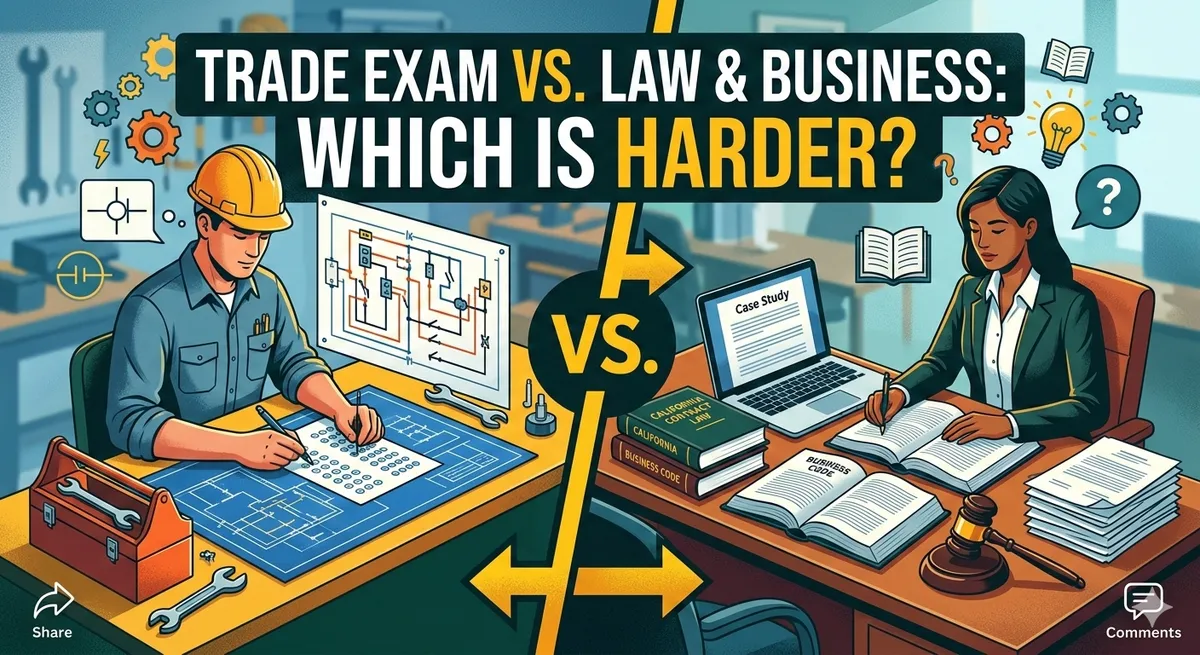
We polled 500 CSLB candidates to find out which portion of the exam gave them more trouble. The results might surprise you.
We surveyed 500 CSLB C-10 exam candidates and asked them the same question: which exam was harder? The results tell an interesting story about how preparation habits affect perceived difficulty.
The Survey Results
Out of 500 respondents who took both the C-10 Trade exam and the Law & Business exam:
- 58% said Law & Business was harder — despite having more study time for the Trade exam
- 34% said the Trade exam was harder — mostly those with less than 5 years of field experience
- 8% said they were about equal — typically those who studied both equally
The most striking finding: candidates who allocated at least 40% of their study time to L&B had a91% first-attempt pass rate, compared to just 67% for those who spent less than 20% of their time on L&B.
Why Law & Business Surprises People
The Trade exam tests knowledge that electricians use daily. Even without studying, most experienced electricians already know a significant portion of the material from hands-on work. The Law & Business exam, however, introduces entirely new topics that most electricians have never encountered:
- Mechanics lien procedures: Complex timelines and legal procedures that don't come up in daily electrical work.
- Employment classifications: The ABC test for independent contractors, prevailing wage requirements, and workers' comp rules.
- Contract law nuances: Specific California requirements for home improvement contracts, change orders, and the right to cancel.
- Financial management: Job costing, overhead allocation, and reading financial statements.
The Bottom Line
The Trade exam tests what you already know. The L&B exam tests what you don't. That's why it feels harder. The solution is simple: allocate enough study time to L&B and treat it with the same seriousness as the Trade exam.
C-10 Trade Exam: What to Expect
The Trade exam covers the technical aspects of electrical contracting:
- NEC code knowledge: Articles 210, 220, 250, 310, 430, and California amendments
- Electrical calculations: Load calculations, voltage drop, conductor sizing, motor circuits, box fill, and conduit fill
- Installation practices: Wiring methods, grounding and bonding, overcurrent protection, and equipment installation
- Safety: Electrical safety practices, lockout/tagout procedures, and PPE requirements
- California-specific requirements: Solar PV installation, EV charging, Title 24 Energy Code
Law & Business Exam: What to Expect
The L&B exam covers business operations and California law:
- Mechanics lien law: Preliminary notices, lien deadlines, stop payment notices, payment bonds
- Contract law: Valid contracts, breach remedies, home improvement contracts, change orders
- Employment law: Workers' comp, employee classification, prevailing wage, wage and hour laws
- Cal/OSHA safety: IIPP, electrical safety orders, trenching, fall protection, reporting requirements
- CSLB regulations: License classifications, advertising rules, grounds for discipline
- Financial management: Estimating, job costing, insurance, bonding, basic accounting
Our Recommendation: Study Both Equally
The ideal study split is 55% Trade / 45% L&B for experienced electricians, or 50/50 if you have less than 5 years of experience. Remember: you must pass both exams to get your C-10 license. A perfect score on the Trade exam means nothing if you fail L&B.
- Experienced electricians (10+ years): You likely know most of the Trade material from daily work. Spend more time on L&B.
- Mid-career electricians (5-10 years): Split your time roughly 50/50 between Trade and L&B.
- Less experienced candidates (under 5 years): You may need more Trade study time, but don't neglect L&B — start studying L&B at least 3 weeks before your exam date.
Schedule Strategically
You can take both exams on the same day or schedule them on different days. Most candidates prefer to take them on separate days to avoid mental fatigue. If you're more confident in one exam, take that one first to build momentum and confidence for the second exam.
Ready to Pass Your Exam?
Put your knowledge to the test. Try our free California C-10 practice test to see where you stand, or upgrade to our Premium Preparation Course for unlimited mock exams, detailed explanations, and a 100% pass guarantee.
Recommended Articles
Master to C-10 Contractor: Is the License Worth It?
The pros and cons of leaving your steady paycheck to start your own CSLB-licensed electrical contracting business.
Launching Your C-10 Business: The First 30 Days
A tactical guide to launching your CSLB-licensed business: forming an LLC, getting bonds, and finding customers.
Real Talk: How Much Do C-10 Contractors Actually Make?
We break down the potential income for licensed electrical contractors in California, from solo operators to large firms.